Seminar Overview
From April 23 to 25, the seminar titled “Philosophical Reflections on Artificial Intelligence” was held in JianDe, Zhejiang. Over 90 experts and scholars from fields such as philosophy, artificial intelligence, ethics, and Marxist theory participated, discussing topics related to the transformation in the era of intelligent agents, alignment of generative AI values, boundaries of AI capabilities, human-machine relationships, and algorithmic ethics.
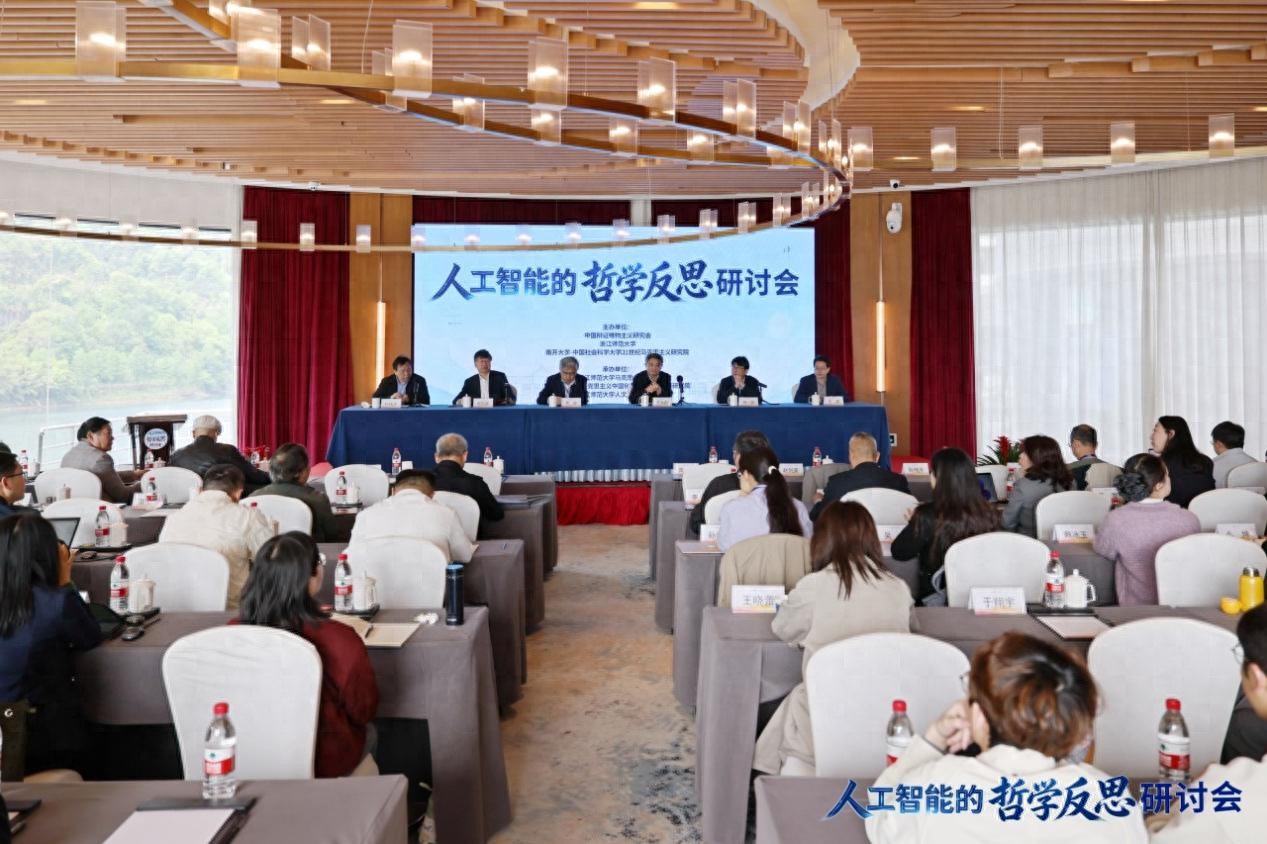
Unlike typical technology forums, this seminar focused on fundamental questions behind artificial intelligence: As machines become more human-like, what does it mean to be human?
Keynote Insights
During the opening ceremony, Zhao Jianying, a member of the 14th National Committee of the Chinese People’s Political Consultative Conference and a professor at the Philosophy Department of the Chinese Academy of Social Sciences, pointed out that artificial intelligence is deeply integrated into various fields such as production, life, governance, education, healthcare, and culture. It not only changes production and lifestyle but also reshapes the relationships between humans and technology, society, and each other. AI brings efficiency improvements and new forms of civilization, raising philosophical questions that must be addressed.
Wang Weiguang, president of the Chinese Dialectical Materialism Research Association and a lifetime professor at Nankai University, emphasized in his online speech that artificial intelligence merely simulates certain functions of the human brain. Human thinking possesses social, historical, practical, and subjective characteristics, which fundamentally differentiate it from AI. In the face of the intelligent era, it is essential to maintain a dialectical materialist perspective and correctly understand the boundaries of AI capabilities.
Focus on Risks and Boundaries
Discussions during the seminar highlighted the risks, values, and boundaries of artificial intelligence. Gong Ke, former president of Nankai University, argued that while AI is fundamentally advanced productive forces, it also poses multiple risks such as incomplete technology, malicious use, over-reliance, privacy breaches, and environmental pressures. He advocated for strengthening safety governance during AI development and promoting its advancement towards green, autonomous, and equitable directions.
Professor Sun Zhouxing from Zhejiang University critiqued the tendency to reduce all life experiences to data and algorithms, emphasizing that human inquiry, imagination, intuition, and creative abilities are aspects that AI cannot truly replicate. As AI becomes more powerful, the humanities must protect those unquantifiable human experiences.
Regarding the boundaries of AI capabilities, Professor Wei Zhewei from Renmin University pointed out that while large language models exhibit complex planning and reasoning abilities, they remain limited in physical world applications due to a lack of bodily perception and multimodal interaction capabilities. Additionally, the phenomenon of model “hallucination” has theoretical roots that are difficult to completely avoid. As AI programming capabilities improve, related job roles and talent cultivation face real challenges.
Human-Machine Relationships
In terms of human-machine relationships, Professor Xiao Feng from Shanghai University introduced the concept of “inter-subjectivity between humans and machines,” suggesting that the relationship between humans and AI is neither a traditional subject-object relationship nor a completely equal inter-subjective relationship. Instead, it represents a functional coupling and action collaboration between different entities. This perspective helps transcend the debate over whether AI is human and shifts the focus towards improving the quality and ethical standards of human-machine interactions.
Conclusion
Several scholars also engaged in discussions on value alignment, the “nonsense” dilemma of large models, ethical engineering, embodied intelligence, algorithmic ethics, and changes in knowledge production models, highlighting the profound challenges that AI technology development poses to philosophy, ethics, education, and social structures.
At the closing ceremony, Wang Kun, dean of the Marxism School at Zhejiang Normal University, stated that this conference was not only a high-level academic dialogue but also a profound reflection on how humans can position themselves in the technological era. AI not only empowers human physical capabilities but also begins to enhance human minds and thoughts. The question of where the differences between humans and AI lie remains an open one, and the continuous inquiry itself is an irreplaceable spiritual characteristic of humanity.
Organizers
The conference was organized by the Chinese Dialectical Materialism Research Association, Zhejiang Normal University, and the 21st Century Marxism Research Institute of Nankai University and the Chinese Academy of Social Sciences. The Marxism School of Zhejiang Normal University, the Research Institute for the Innovation of Marxism in China, and the Institute for Advanced Humanities also hosted the event.
Comments
Discussion is powered by Giscus (GitHub Discussions). Add
repo,repoID,category, andcategoryIDunder[params.comments.giscus]inhugo.tomlusing the values from the Giscus setup tool.